Why this page exists
The Church has never attributed a miracle to the Shroud. Devotional stories of healings exist from the legend of King Abgar onward, and none of them is documented. One modern story is: the visit of a ten-year-old English girl to Turin in 1955. It is documented because the people around her wrote letters, and because the man who took her there was famous. The film tells this story through one of its characters. This page tells it from the source, which is Charles Foley's account built from her mother's and her doctors' letters, published in Shroud Spectrum International. Documented Foley
The girl
Josephine Woollam was born in 1945. Her family lived in Gloucester. By 1955 she had osteomyelitis, an infection of the bone, with ulcers on her leg that would not close and abscesses in her lungs, and she was coughing blood. Her doctors had done what they could. A priest had anointed her and given her viaticum. She was expected to die. Foley
The pilot
Group Captain Leonard Cheshire VC had flown a hundred bombing missions, had been the British observer aboard the aircraft that accompanied the atomic bombing of Nagasaki, had become a Catholic in 1948, and had founded the homes for the disabled that still carry his name. He was also, by 1955, a public advocate of the Shroud. Josie's mother wrote to him. He sent Josie a photograph of the Shroud. Foley RAF
Her mother's account is that the ulcers stopped draining that afternoon. The doctors' letters record that over the following weeks her condition improved beyond what they had expected. Foley
The journey
Josie asked to see the cloth itself. Cheshire, recovering from major chest surgery and forbidden to fly, took her overland. They went first to Portugal, where Umberto II, the exiled King of Italy and the cloth's owner, received them and paid for the rest of the journey. Then across Spain and France to Turin. The nurse who was to accompany them dropped out, and Cheshire made the journey with the child alone. Foley Rinaldi
Turin
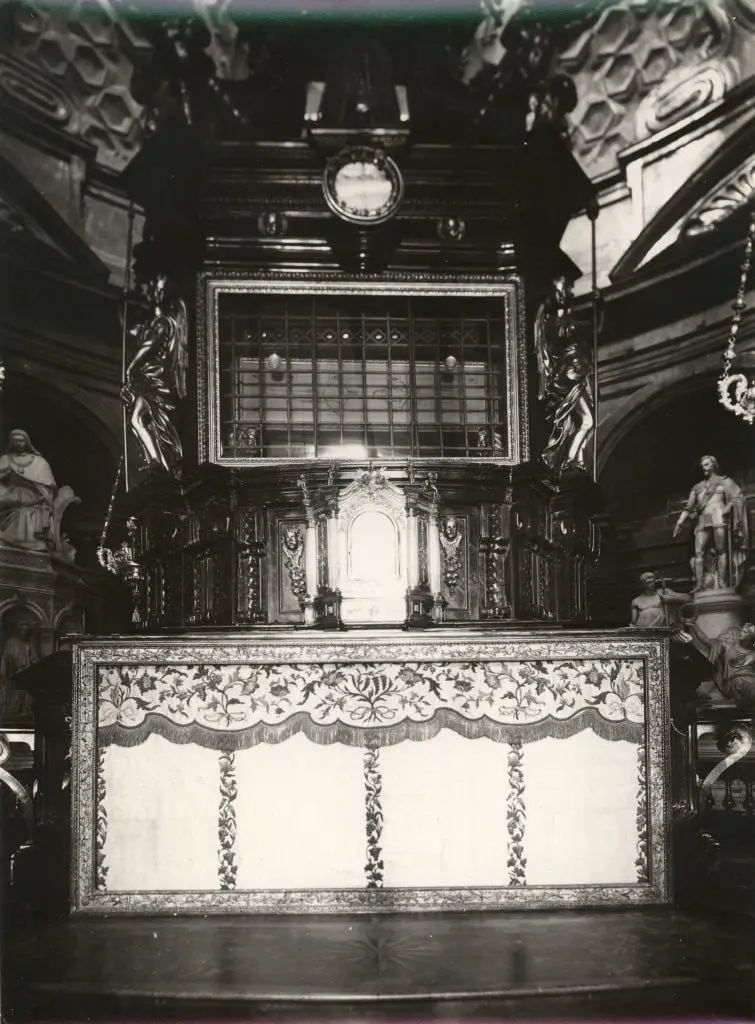
Cardinal Maurilio Fossati, Archbishop of Turin, told Cheshire that a private showing of the cloth "simply could not be done in time." The casket was sealed with many seals and opening it required a process. Josie then showed the Cardinal her new shoes and a white dress, "a wedding dress which my aunt made specially for the blessing." The Cardinal stepped away and made telephone calls. The viewing was set for four o'clock that day. Foley
What happened, in the order the record gives it:
The casket was brought down and laid across the arms of her wheelchair. Nothing happened.
The Cardinal had the outer seals of the casket broken. The Shroud, still wrapped in its red silk and still tied about with its own tapes and seals, was lifted out and laid in her lap, then along her splinted leg. Nothing happened.
Then Josie was allowed to slip her hand inside the red silk covering and touch the cloth.
Nothing visible happened then either. Foley
After
After Turin the ulcers began to close. The disease did not return. The leg itself was beyond saving, and in 1966 it was amputated. She learned to walk on a prosthesis. In 1968 she married Roy Jones. In 1978 she came back to Turin for the exposition, with Cheshire, and walked through the cathedral among the three million. That April the Catholic Herald put her on its front page under the headline "Josie: 'The Shroud Gave Me Courage To Live'." Foley Herald 1978 Rinaldi
She died in 1981, of a condition unrelated to the illness of 1955. Foley
What she said
When she came home in 1955, her mother asked her at Victoria Station what she had got in Turin. Her answer, as her mother recorded it: "More than I went to ask for." Foley
She did not call it a cure. The best-documented witness in the modern history of the cloth chose the humbler claim, and this site makes no larger one for her.
Last checked 2026-10-20.