The object
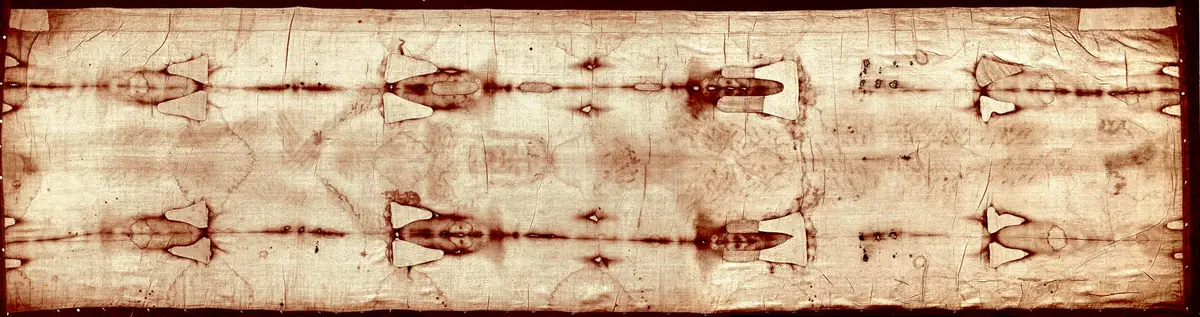
The Shroud of Turin is a single piece of linen about 437 centimeters long and 111 centimeters wide, roughly fourteen feet four inches by three feet seven inches. Documented Chronology It is kept in the Cathedral of Saint John the Baptist in Turin, lying flat in a sealed case; the current case dates from 2000. Before the late 1990s it was rolled on a spool inside a silver-covered casket.
On it, faintly, is the front and back image of a naked man, head to head, as if the cloth had been laid under a body, drawn up over the head, and laid back down over the front. The man is bearded, with long hair, between about five feet nine and five feet eleven, and in his thirties or forties, by most estimates. Claimed Meacham His hands are crossed at the wrists over the groin. There are marks over the whole body front and back consistent with scourging, stains at the wrists and feet, a large stain on the right side of the chest, and stains around the scalp.
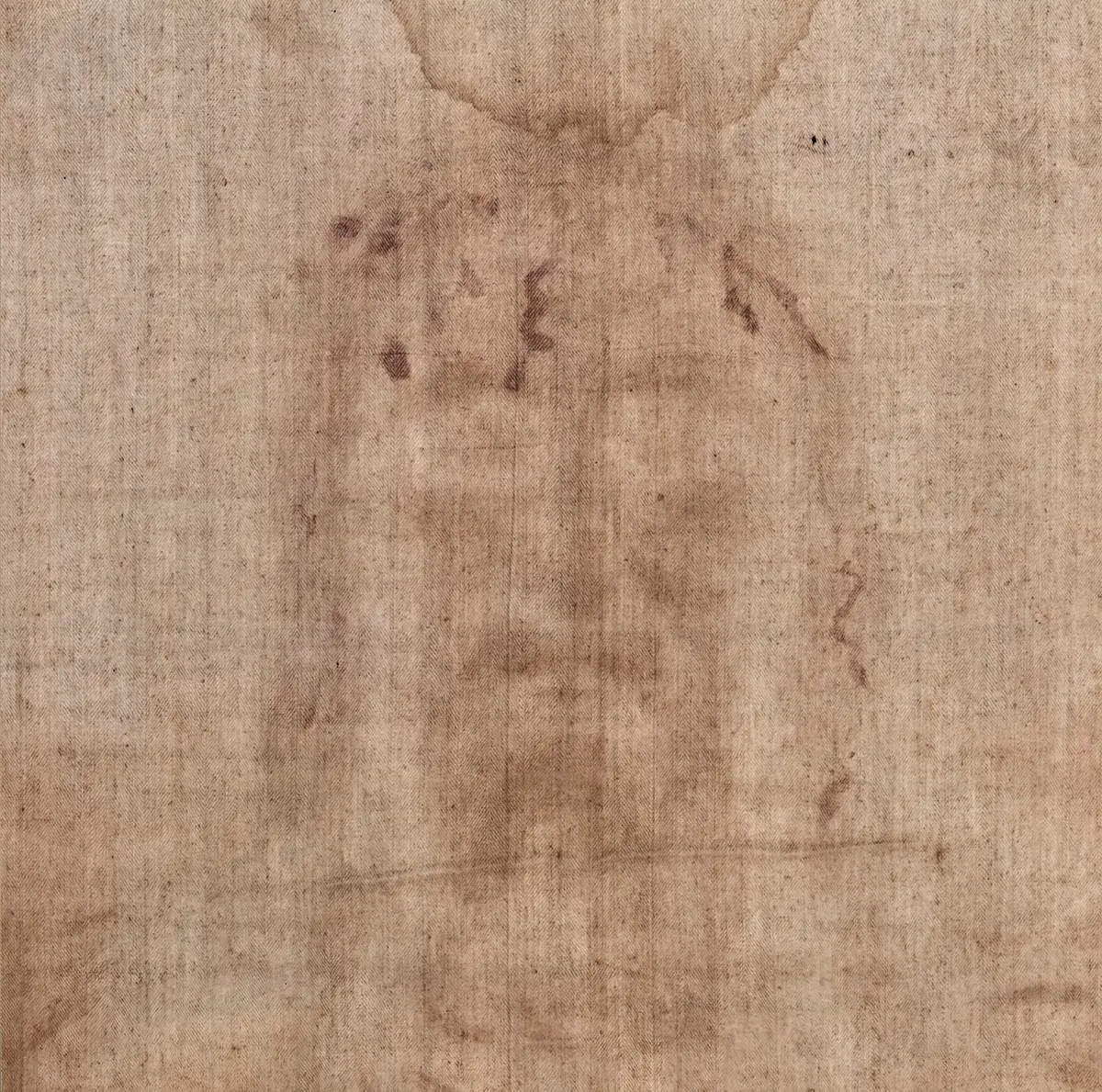
The image is faint. Up close it is a pale yellow-brown discoloration of the fibers, hard to see at all from less than a few feet. From across a room it resolves into a figure. For most of its known history that is all anyone saw: a faint man on a sheet. d'Arcis
The weave
Linen, from flax. The weave is a three-to-one herringbone twill: each weft thread passes over three warp threads and under one, with the direction reversing to make the herringbone pattern. The thread is hand-spun with a Z-twist. Documented Tyrer Raes
This is an expensive weave for any century and an unusual one. When the British Museum assembled control samples for the 1988 radiocarbon test, it could not find a textile to match it, which meant the laboratories could tell which sample was the Shroud by looking. Nature 1989
Whether the weave points to a first-century Near Eastern origin is argued. Some textile scholars allow it. Orit Shamir of the Israel Antiquities Authority has pointed out that excavated Judean linen of the period is S-spun plain weave, not Z-spun twill. Contested Tyrer Shamir No first-century three-to-one herringbone linen is known to survive anywhere. The side strip along one long edge is attached by a stitch that the textile conservator Mechthild Flury-Lemberg compared to a first-century seam found at Masada; critics say the stitch is generic. Contested Flury-Lemberg
In 1973 the Belgian textile expert Gilbert Raes was allowed to cut a small sample from one corner. He found traces of cotton (Gossypium herbaceum) in the warp and weft of that corner sample, and none in the strip from the side. Documented Raes Raes read the cotton as a sign the linen "had been woven in places where cotton had also been woven," a cotton that "existed in the Middle East." Others read it as contamination or later repair. Contested The corner Raes sampled is the same corner the 1988 radiocarbon strip was cut from. Nature 1989
The damage
The cloth has been through at least one fire that nearly destroyed it.
On the night of 3 to 4 December 1532 the Sainte-Chapelle at Chambéry, where the House of Savoy kept the Shroud, caught fire. The cloth was folded in forty-eight layers inside a silver reliquary. The reliquary began to melt. A drop of molten silver burned through one corner of the folded packet, which is why the burn holes repeat in a symmetrical pattern down both sides of the cloth. Water thrown on the casket left the large diamond-shaped stains. Documented Poor Clares
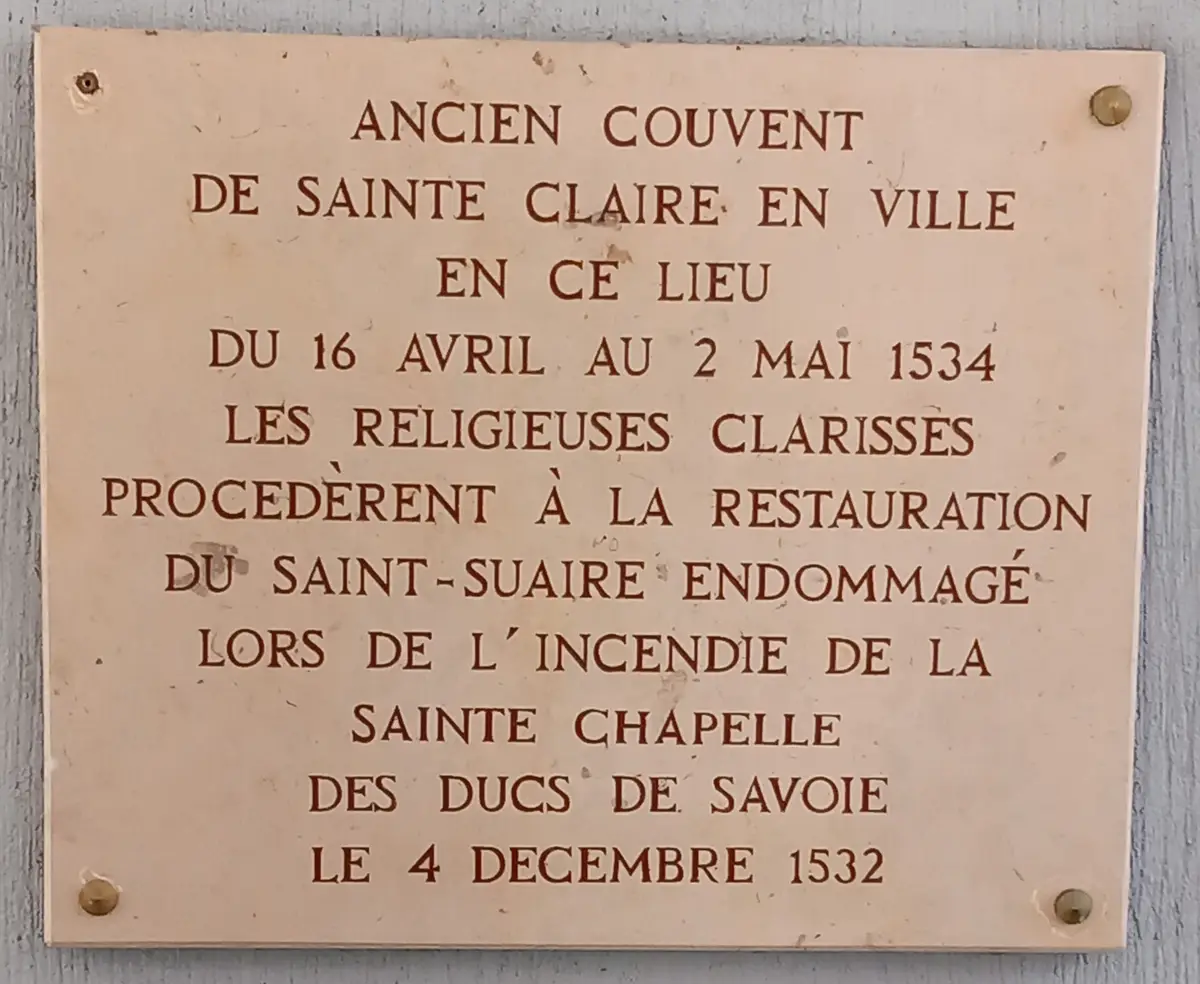
Between 16 April and 2 May 1534 the Poor Clare nuns of Chambéry repaired the cloth. They sewed triangular patches over the burn holes and stitched a linen backing cloth, the Holland cloth, over the whole back. Their written account of the repair survives, and it includes their description of the image as they saw it, inches away, for two weeks. Documented Poor Clares
There are also four groups of small burn holes in an L shape, the so-called poker holes, which predate the 1532 fire. They appear in a copy of the Shroud made in 1516 and, proponents argue, in a drawing in the Pray Codex of about 1192. Contested History
In 2002 a restoration directed by Flury-Lemberg removed the 1534 patches and the Holland backing, trimmed the charred edges, and sewed on a new backing. The work was done without consulting the wider research community, and some researchers argued that trace evidence was lost with the patches and backing. Contested Conservation
The side strip and the missing corners
A strip about eight centimeters wide runs the length of one side, joined to the main cloth by a seam. Two rectangular pieces are missing from the corners of that side. The reason for the strip is not known. Theories include a later addition to center the image for display, and a piece cut off and sewn back on. Contested Tyrer
What is on it, apart from the image
- Blood, in the forensic sense, at the wounds. See The Blood. Documented Heller and Adler
- Serum halos around some of the blood, visible under ultraviolet. Documented Miller and Pellicori
- Scorches from 1532, which fluoresce reddish-brown under ultraviolet. The image does not fluoresce. Documented Miller and Pellicori
- Water stains from 1532 and from an earlier wetting whose date is argued.
- Pollen, collected on tape by Max Frei in 1973 and 1978. What species, and what that proves, is contested. See The Case Against. Contested Frei
- Particles of iron oxide, found by Walter McCrone on the 1978 tapes and by the project's own chemists, who attributed them to the retting of the flax and to the water stains. Contested Heller and Adler McCrone
- Debris of several centuries: wax, insect parts, fibers from the silk coverings, pollen, and whatever the hands of pilgrims and clergy left. Heller and Adler
- Human and plant DNA from many lineages, reported in 2015. The authors wrote that the data were "compatible with both alternative scenarios," meaning a cloth made in India or the Near East and carried to Europe, or one made in Europe and handled by people from many places. Contested Barcaccia 2015
What the eye sees and what the camera sees
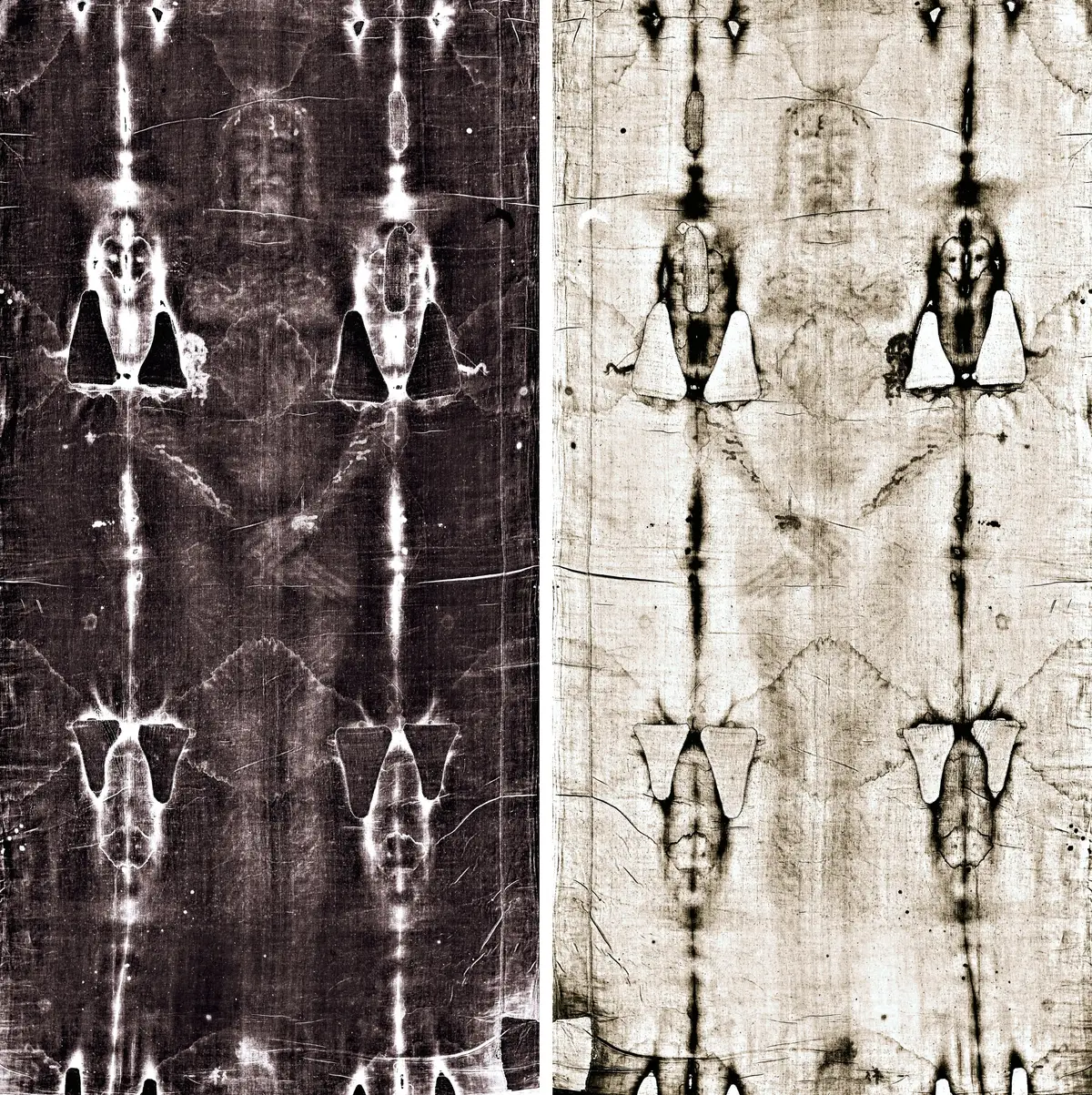
To the eye the image is a faint negative: dark where the cloth was closest to the body, pale where it was not. Photographed and reversed, it becomes a vivid, lifelike positive with the shading of a face lit from the front. That reversal, first seen by Secondo Pia in 1898, is the beginning of the whole modern argument. See The Image.
Last checked 2026-10-20.